If you have driven through the Arbour Park or Nottingham Hills neighborhoods in Newark lately, you have probably noticed how many roofs have gone from a clean gray or tan to a streaky, blotchy dark brown or black. Same story over in Pike Creek, along Milltown Road, and in the older ranch-style homes closer to the University of Delaware campus in zip code 19711. Those stains are not soot, not manufacturing fallout, and not old age. They are Gloeocapsa magma, a cyanobacteria that thrives in the Mid-Atlantic's humid summers and mild winters, feeds on the limestone filler in asphalt shingles, and spreads from one roof to the next by wind and rain.
True Blue Pro Wash serves Newark and the surrounding areas of New Castle County, including Pike Creek and Christiana (19713), with professional roof soft washing that kills the algae colony at the root rather than just rinsing the surface. We use a low-pressure, high-dwell cleaning solution, the same ARMA-recommended approach that shingle manufacturers require to keep warranties valid. You will not see one of our technicians standing on your ridge cap with a pressure wand. That approach cracks shingles, voids warranties, and does nothing to prevent regrowth.
Why Newark Roofs Get Hit So Hard
Newark sits right in the Brandywine Valley's humidity pocket. Summers here run hot and wet, and the tree canopy in neighborhoods like Cooke's Mill and Brandywine Springs holds moisture against north-facing roof planes well into the afternoon. That sustained dampness is exactly the environment Gloeocapsa magma needs to establish a colony. Once a few spores land from a neighboring roof or a passing bird, they multiply fast. By the time you can see the streaks from the street, the colony has already been growing for one to two years.
Freeze-thaw winters make things worse. Water gets under the algae mat during a January thaw, then expands when temperatures drop again overnight. Over several seasons this accelerates granule loss, shortens shingle life, and can push up heating bills because dark staining absorbs more solar heat in summer while the underlying damage reduces insulation value. Catching it early with a soft wash treatment is almost always cheaper than a partial re-roof down the road.
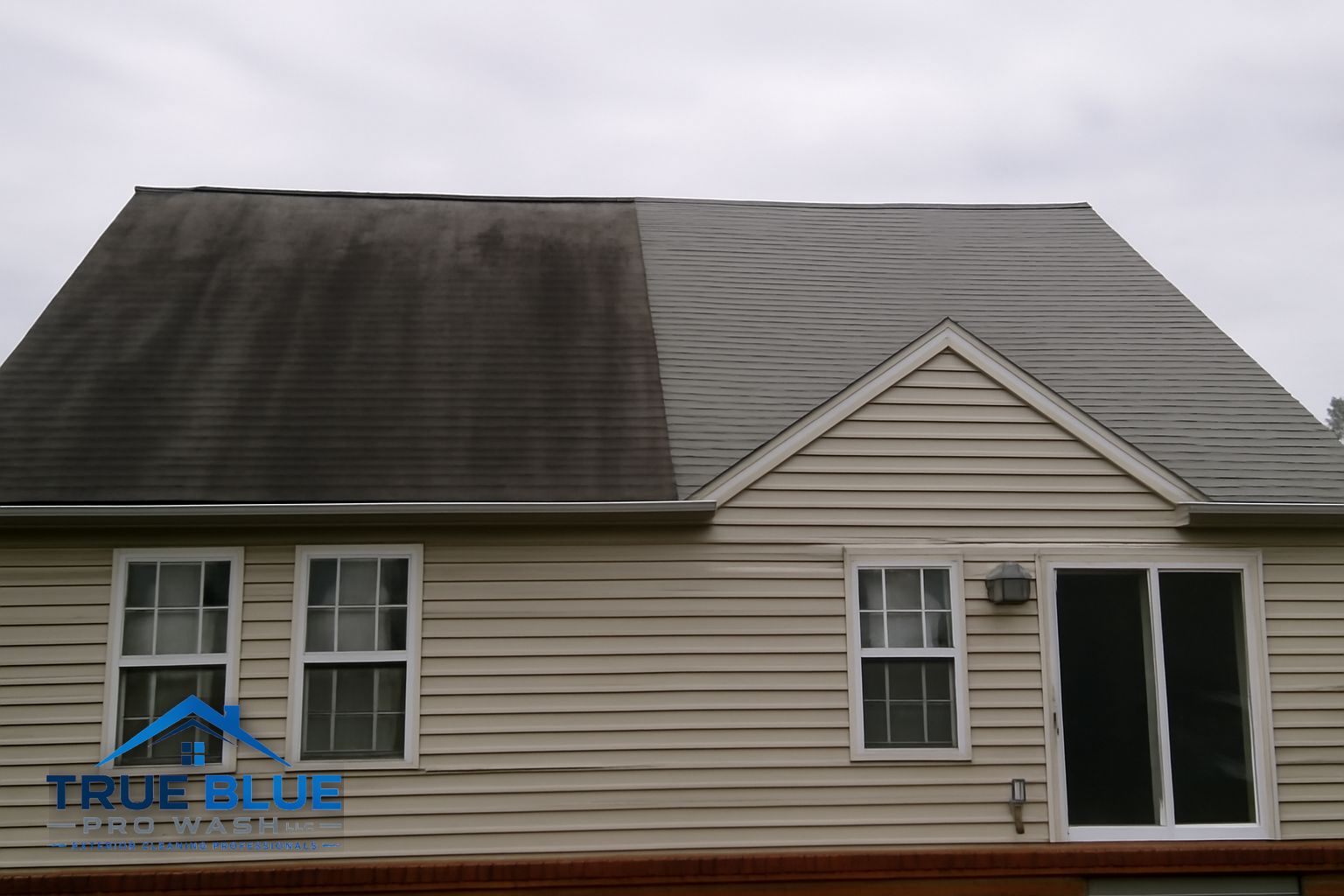
How Our Roof Soft Washing Process Works
Roof soft washing is a two-step process. First, we apply a carefully diluted cleaning solution that is biodegradable and formulated specifically for asphalt shingles, metal roofs, and tile. The solution penetrates the algae colony, kills the organism down to the root structure, and breaks apart the dark pigment it produces. Second, we rinse at very low pressure, well below what a standard garden hose puts out, so the solution and the dead organic matter lift away cleanly without disturbing granules or flashing. We also wet down your landscaping before we start and rinse it thoroughly when we finish. Your shrubs and flower beds are not collateral damage on our jobs.
What We Treat on a Typical Newark Roof Job
- Gloeocapsa magma black streaks on asphalt shingle roofs
- Green algae and moss on north-facing slopes and shaded valleys
- Lichen spots that have bonded to the shingle surface
- Mold and mildew accumulation around dormers, skylights, and chimneys
- Oxidation staining on metal roof panels and ridge caps
- Debris and organic buildup in roof valleys that hold moisture
Neighborhoods and Zip Codes We Cover in the Newark Area
True Blue Pro Wash runs crews through Newark (19711 and 19713) on a regular schedule. If you are in Brookside, Pike Creek Valley, Glasgow, White Clay Creek Estates, or anywhere along the Route 273 corridor toward Christiana, we are already in your area most weeks. We also service the older homes near Delaware Avenue and Cleveland Avenue closer to downtown Newark, where the mature tree canopy creates persistent shade on north and east-facing roof sections. Pollen season in April and May leaves a thick green film on many of these roofs that can be mistaken for algae but is actually a separate problem we address during a full roof wash.
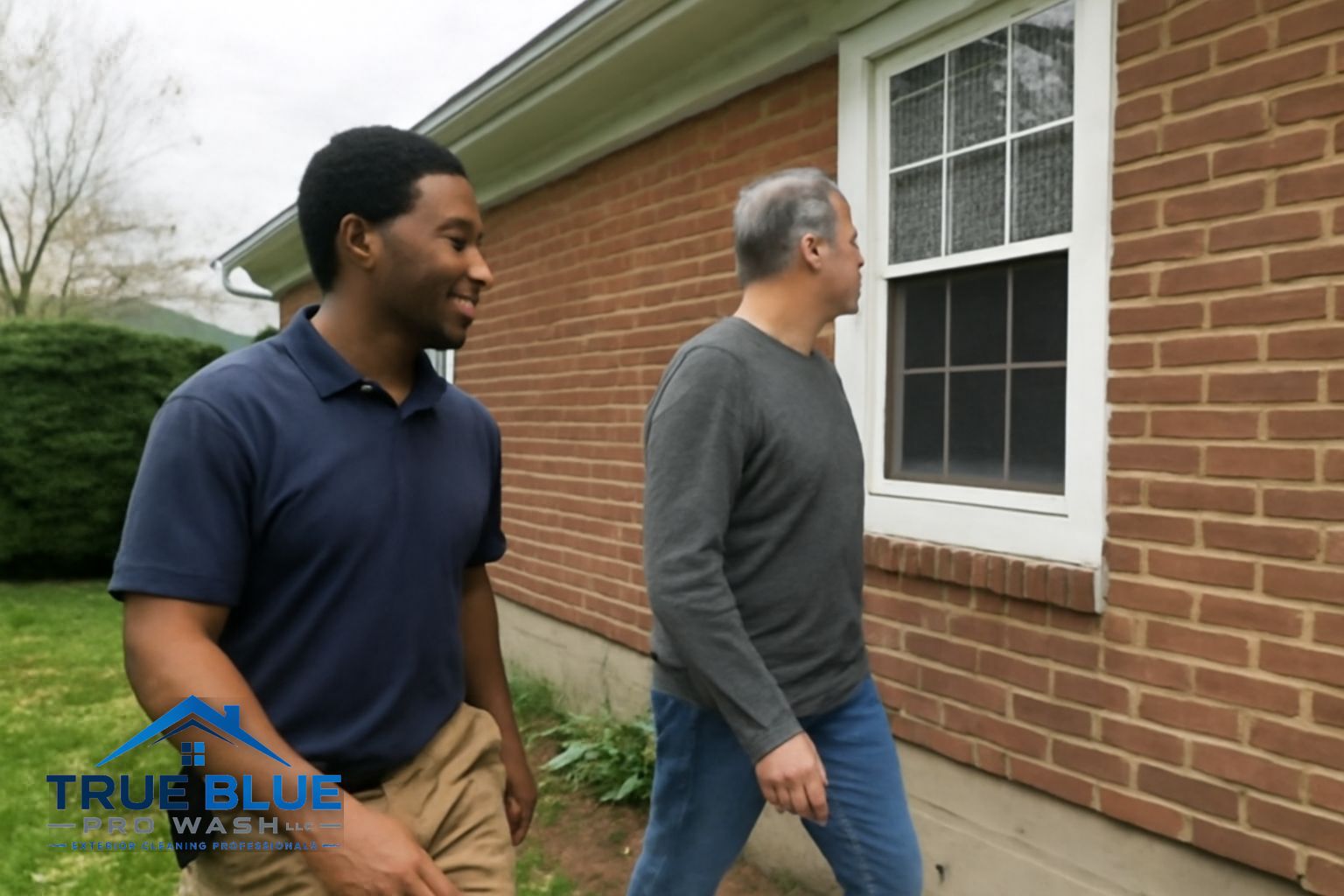
Roof Soft Washing vs. Pressure Washing: Why It Matters for Your Shingles
We hear from homeowners in Pike Creek and Christiana who had a previous company show up with a standard pressure washer and blast the algae off. It looks clean for a few months. Then the streaks come back faster than before, because the root structure of the algae colony was never killed, it was just scrubbed back temporarily. Worse, high-pressure cleaning strips granules from shingles in large quantities. Those granules are the UV protection and fire resistance layer of your roof. Once they are in your gutters, they are gone. Asphalt shingle manufacturers including Owens Corning and GAF specifically state in their warranty documentation that high-pressure washing voids coverage. Soft washing is the only method that both kills the algae and keeps the warranty intact.
Signs Your Newark Roof Needs Attention Now
- Black or dark brown streaks running vertically down the slope from ridge to eave
- Green or gray-green patches on shaded north or east-facing sections
- Fuzzy moss growth along shingle edges or in roof valleys
- Circular lichen spots that look like they are embedded in the shingle
- Granules collecting in gutters or downspout splash blocks in large quantities
- Interior ceiling stains that followed a period of heavy rain
Bundling Roof Washing With Gutter Cleaning in Newark
Most Newark homeowners who call us for a roof soft wash end up bundling the job with a gutter cleaning or gutter brightening service, and it makes good practical sense. Once the roof is clean and we rinse, the flush-down carries dead algae, granules, and organic debris into your gutters. If those gutters are already half full from the spring oak and sweet gum leaf drop, you end up with a clog the same afternoon the roof looks its best. Having us clean and flush the gutters on the same visit keeps everything working together and saves a second trip charge. Ask about our combined pricing when you call.
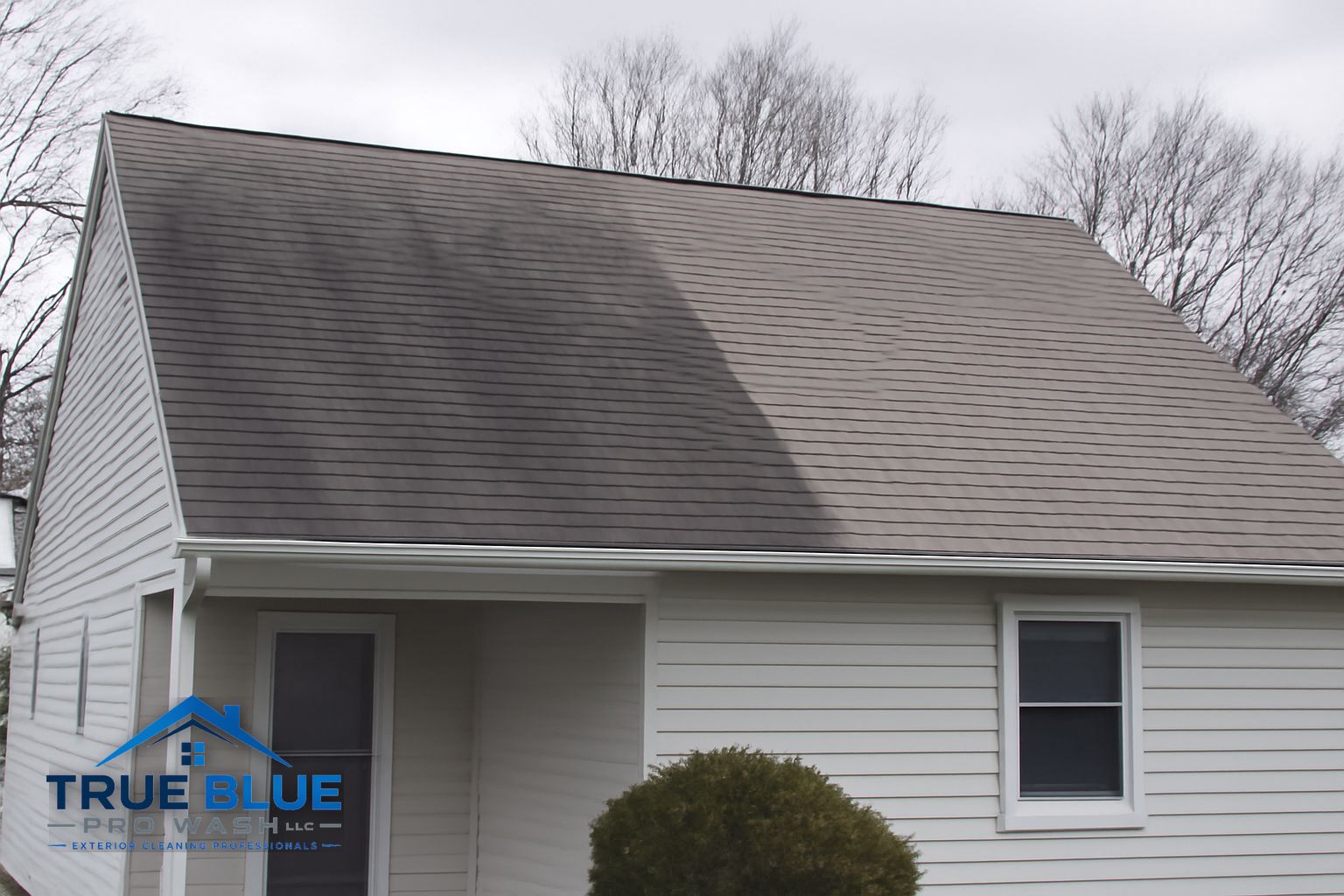
How Much Does Roof Soft Washing Cost in Newark, DE?
Pricing on roof soft washing depends on the square footage of the roof plane, pitch, number of stories, and the degree of algae or moss coverage. A typical single-story ranch in Brookside or White Clay Creek Estates comes in at a different price point than a two-and-a-half-story colonial off Paper Mill Road. We do not quote flat rates online because a number that is accurate for one house is off by hundreds of dollars for another. What we can tell you is that a professional soft wash almost always costs a fraction of what even a partial shingle replacement runs, and a clean roof can meaningfully improve curb appeal and home value in a competitive Newark real estate market. Call us at (302) 757-9755 for a free, no-obligation estimate. We will look at the roof, walk the property, and give you a written quote before any work begins.
Frequently Asked Questions
Will roof soft washing damage my asphalt shingles?
No. Soft washing uses very low water pressure, well below what a garden hose produces at the nozzle, combined with a biodegradable cleaning solution. This approach is specifically recommended by the Asphalt Roofing Manufacturers Association and is required by most major shingle warranty programs including Owens Corning and GAF. High-pressure washing, by contrast, strips granules and voids those warranties. We only use the soft wash method on shingle roofs.
How long does it take for the black streaks to disappear after treatment?
In most cases the majority of the streaking is gone the same day, especially on fresh to moderate algae growth. Heavier staining or embedded lichen may take two to four weeks to fully fade as rain and sunlight finish the process after the initial treatment kills the organism. We will let you know what to expect during your estimate based on what we see on your specific roof.
How often do Newark homes need a roof soft wash?
Most homeowners in the Newark and Pike Creek area see a recurrence of Gloeocapsa magma algae in three to five years depending on tree coverage, roof orientation, and climate patterns. North and east-facing slopes in heavily shaded neighborhoods like Cooke's Mill tend to re-colonize faster than south-facing slopes with full sun exposure. We can discuss a maintenance schedule during your estimate that makes sense for your specific roof and site conditions.
Is the cleaning solution safe for my landscaping and pets?
Yes. We pre-wet all surrounding plant material before applying the roof cleaning solution, and we do a thorough rinse of beds, shrubs, and lawn areas once the treatment is complete. We ask that pets stay indoors or away from the work zone during the job and for about 30 minutes after we finish rinsing, just as a precaution. Once the solution has been rinsed and dried, the area is safe.
Can you clean a roof in Newark during the winter?
We can treat roofs in cool weather as long as temperatures are above freezing at the time of application and expected to stay above freezing for several hours after. The cleaning solution needs dwell time to work effectively and should not freeze on the shingle surface. Delaware winters can be unpredictable, so we schedule cold-weather roof jobs on a case-by-case basis. Call us and we will let you know what is feasible for your timeline.
Do you also clean gutters on the same visit as the roof wash?
Yes, and we recommend it. After a roof soft wash, the rinse water carries organic debris, dead algae, and loosened material into your gutters. If those gutters are already clogged from spring or fall leaf accumulation, you can end up with an overflow problem the same day the roof looks its best. Bundling a gutter cleaning and flush into the same visit is more efficient and typically costs less than scheduling two separate trips. Ask about combined pricing when you call (302) 757-9755.